
DAILY DEVOTIONAL
Thursday, June 28, 2018
All the people in the synagogue were furious when they heard this. They got up, drove him out of the town, and took him to the brow of the hill on which the town was built, in order to throw him off the cliff. But he walked right through the crowd and went on his way. – Luke 4:28-30

I am intrigued by the drama of this encounter between Christ and his hometown synagogue.
I dare raise a paraphrase by way of parallel. All the church members were furious at what the preacher said. The committee met and said, “We must fire this pastor for his speaks most troubling words. How dare he question our ways!” But the pastor moved on from there and continued being faithful to his Lord.
Those who were about toss this young rabbi over the cliff, these were church-going people. They probably attended classes on the Law, the Prophets, and the Writings. They all went through the rite of passage into adulthood. They were Jews of a Jewish nation. They were people who prayed. They were people who sang the old hymns. They were people who kept the rules their forefathers wrote. And they dragged a rabbi to the edge of a cliff. Synagogue people sometimes did unholy acts in unholy ways in a false delusion that they were protecting the ways of God. And church-going people sometimes do unholy acts in unholy ways in a false delusion that they are protecting the ways of God.
But it is the manner of Christ in this moment of crisis that models for me the Christ-incarnated way we are to carry ourselves and to advance the work of God’s Realm of a More Perfect Love. “He walked through the crowd and went on His way.” No kowtowing to the rage of the crowd, no surrendering to the status quo, no fighting back using their unholy ways … no, He simply carried Himself with dignity and walked on in His pilgrimage of faith.
I seek to face the judgmental ones with rage in their voices and murderous intentions in their hearts … with nobility of soul, without resorting to the ways and will of the crowd, and continue in the authentic ways of the Lord.
Always in Christ’s Service,
Fr. Charitas de la Cruz
 The gift to the world … the life of Christ, to learn from words, to learn from His example, to learn from the mission He undertook. But there is more. This gift to the world also includes the Life of Christ that continued on in the lives of those who dared trust His words and His ways. The Church, the essential Church, is the living out of this gift of Christ’s very life in our own lives together. We are the ongoing earthly Life of Christ living on with the “genetics” of the Lord’s Spirit within us and among us. We are the ongoing voicing of Christ’s words and Christ’s stories. We are essence of the Divine in the experience of the human, as was Christ in His incarnation of the Love and Concern of God.
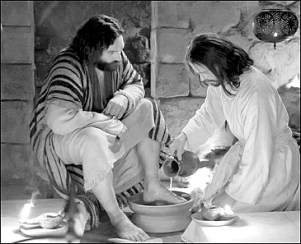 With a basin of water and a towel, Christ knelt before Simon Peter, who said to him, “Lord, are you going to wash my feet?”
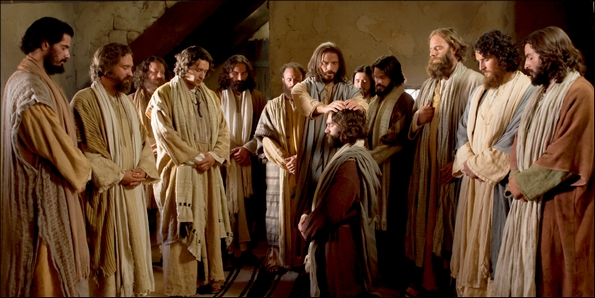 Christ has set us apart for a holy work. This is the meaning of the action, to sanctify. And this holy work given to the disciples, both those gathered in upper room that night before the crucifixion and we who have followed in their footsteps and in their spirit, is to care for the world without adopting and using the wayward ways of the world. As did Christ gave His own life a few hours after He prayed this prayer, so we, the disciples through time, sacrifice our old world ways so that we might then live with ways that remain faithful to the Truth of God, the ways that are also the ways of the heavenly life.
 It is in the active making of the peace, in the active work of reconciliation, in the taking the initiative to begin the process of forgiveness and restoration, that we are active participants in the family business of the Lord. We invest ourselves not in blaming, judging, condemning the world, but rather in saving this world by transforming this world. We are then doing as Christ … the one who kept faithful to His work even the cross when He reached on behalf of the people, “Father, forgive them for they know not what they do.” In a certain sense, the common, worldly sense, He should have demanded retributive justice against his accusers and executioners, against the mockers and those standing by … but instead He offered an initiative of grace, an offer of restorative justice, an offer of a new beginning filled with new hope.
 Two men met face to face, even heart to heart, both knowing in their own mind the critical moment they shared. One of those men was a politician, the other, a rabbi. For the most part, both men the truth of the situation, but the rabbi knew the truth of this cosmic drama and the ways of the human heart, while the politician knew the truth of his precarious political circumstance and the ways of kings and crowds.
 I have learned in life, probably too late in life, that I must keep returning to Christ so that He might provide yet another touch of bringing purer clarity to my vision. And as the Lord washes my eyes over and over, I see all the clearer.
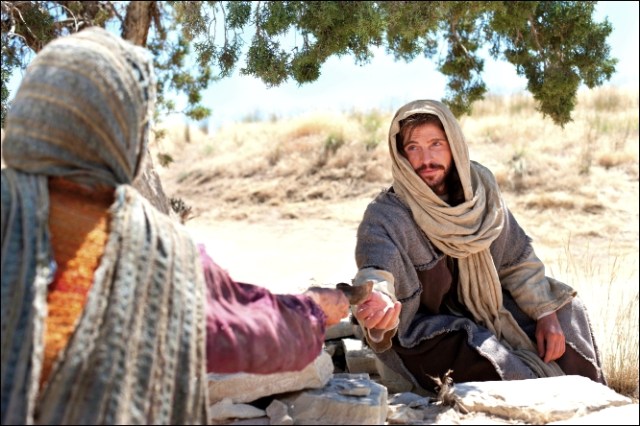 For nearly five centuries, from the time of Ezra and Nehemiah, the time when the exiled Hebrews returned from Babylon, the “pure and true” Jews culturally separated themselves from the Hebrews they considered to be unfit to live in the New Jerusalem. You see … the Samaritans were among those who did not leave the land during the period of the Exile. So the Samaritans, no longer able to worship in Jerusalem, returned to the pre-Davidic faith and worship on the mountain, Mount Gerizim. Thus the Jews and the Samaritans were living in a religious apartheid, a segregation for the sake of co-existence.
 At dawn Jesus appeared again in the temple courts, where all the people gathered around him, and he sat down to teach them. The teachers of the law and the Pharisees brought in a woman caught in adultery. They made her stand before the group and said to Jesus, “Teacher, this woman was caught in the act of adultery. In the Law Moses commanded us to stone such women. Now what do you say?” They were using this question as a trap, in order to have a basis for accusing him.
 Jesus said, “Let the little children come to me, and do not hinder them, for the kingdom of heaven belongs to such as these.” – Matthew 19:14
 Into the Sacred Hills of Jade