
DAILY DEVOTIONAL
Monday, June 18, 2018
When Jesus had entered Capernaum, a Roman military officer came to Him, asking for help. “Lord,” he said, “my servant lies at home paralyzed, suffering terribly.” – Matthew 8:5,6
A Roman military officer there in Galilee to enforce the Roman occupation of that land comes to a Galilean rabbi asking for help. I find that rather unexpected, but then again, on several occasions certain Roman officers were viewed positive light.
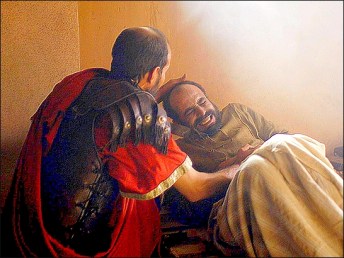 Here we experience a Roman military officer who has compassion on his servant. Not a man wielding an intimidating sword or demanding that this Galilean obey his orders… but a compassionate man respectfully, rather humbly, asking Christ for a measure of healing mercy. In the end, the military officer’s request is granted and Christ affirms him as a man of great faith. Later, other soldiers would brutally whip this rabbi, mock this rabbi, drive nails into his hands, all the while obeying orders. But this one soldier acted in response to a greater command … to alleviate the suffering of a commoner, a servant.
The Christian has always struggled, or at least, those who are sensitive in spirit, with the tension between obedience to man’s law and obedience to the conscience of God. Sometimes law and conscience coincide or at least tolerably coincide, but at other times, they cannot be reconciled, the demands of human law and the demands of a conscience Divinely graced.
Sometimes in human history and it has been often when Christian were called to be faithful to conscience, that Divinely graced conscience and were made martyrs by their lack of “patriotism, one defined in terms of law-and-order”.
Always in Christ’s Service,
Fr. Charitas de la Cruz
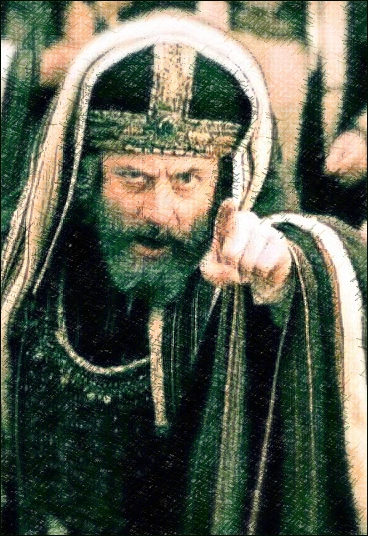 Supposedly they were godly men, these Pharisees so committed to keeping the Law and these Bible scholars who knew every jot and tittle of the scriptures … yet their zealotry led them into vile treachery. They would watch this ragamuffin rabbi from the rough country of Galilee to see if He would yield to their authority and keep the letter of the Law. They believed that a person could do no work on the holy Sabbath, though did have loopholes and self-exempting exceptions. Would this Jesus goes against the Law of God by healing a wounded man? Who is this rabbi who breaks with tradition, who does good on the holy Sabbath?
 I think of the horrific scene in Sophies’ Choice when the Nazi guard executes a cruel law all the more cruelly by separating child from mother. That Nazi guard was on one level obeying the law; but on so many other levels, he was disobeying the moral imperative. When I revisit that scene I always cry.
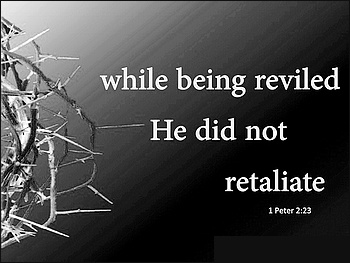 Zealous people can venture into cruelty. Defenders of a certain point-of-view can step over the line into cruelty. People who are trying to gain control can resort to cruel ways. But as Christ modelled for His followers … we must not allow the ways of the revilers and persecutors become our own ways. We must not seduced into the hatred they espouse.
 “Neither this man nor his parents sinned,” to this Christ responded, This happened so that the works of God might be displayed in him…” – John 9:1-3
 Most know well this teaching metaphor from the Sermon on the Mount. This metaphor has become part of our vernacular when we say of a person, “They are the salt of the earth.” In fact, this popular idiom may pull us away from the powerful context of this place and time in which Christ taught. For you see, the people of that region were custodians of the actual salt for the Roman Empire, the occupiers of their land. The salts of the Dead Sea were as gold in those days, an easily transferable means of monetary exchange. It was used as “salary” for the vast Roman armies. Probably it was the salt that made the Romans put up with this troublesome population of Jews.
 believes that the Sabbath was a celebration of Creation and thus is celebrated with a creative spirit. Inherent in the Hebrew word for “rest”, nuach, is the sense of renewal by way of re-creation. The Sabbath is a time devoted to learning from our six days of work, our six days to living life to the fullest, and then to “re-create” our souls with the wisdom and understanding we have gained. Each Sabbath might be viewed as a mile marker placed on our journey to wisdom, spiritual maturity, and a More Perfect Love.
 How do we measure the prosperity of our lives or our land? How do we define ourselves by worldly definitions of this political party or this ideology or this economic class or this nationality? How do we measure the worth of ourselves and others, by what measure do we use to determine the success of our living?
 Into the Sacred Hills of Jade